1. Introduction: The Metaphysics of Gold in Textile Art
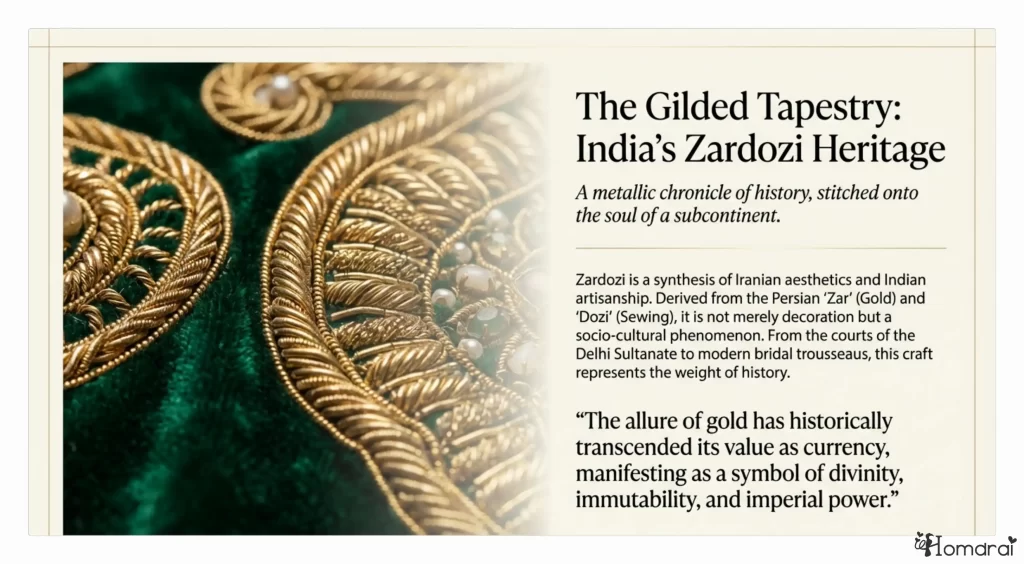
The allure of gold has historically transcended its value as currency, manifesting as a symbol of divinity, immutability, and imperial power. In the Indian subcontinent, this fascination found its most sophisticated expression in Zardozi—a heavy, elaborate form of metal embroidery that stitches history onto velvet and silk. Derived from the Persian lexicon, where Zar denotes gold and Dozi implies the act of sewing , this craft represents a centuries-old synthesis of Iranian aesthetics and Indian artisanship. It is not merely a decorative technique but a socio-cultural phenomenon that has adorned the courts of the Delhi Sultanate, the tents of Mughal emperors, and the bridal trousseaus of the modern South Asian elite.
This report offers an exhaustive analysis of the Zardozi ecosystem. It moves beyond a superficial overview to dissect the historical trajectories that brought the craft from Persia to the Indo-Gangetic plain. It maps the granular geography of the trade, identifying specific villages (mohallas) in Lucknow, Bareilly, and Agra where the art survives. It scrutinizes the technical dichotomies between Karchobi and Kamdani, evaluates the economic precariousness of the artisan class, and explores the contemporary resurgence of the craft through the lens of high fashion and government interventions like the Geographical Indications (GI) registry.
2. Historical Trajectory: From Rigvedic Hiranya to Mughal Karkhanas
2.1 Ancient Precursors and the Persian Infusion
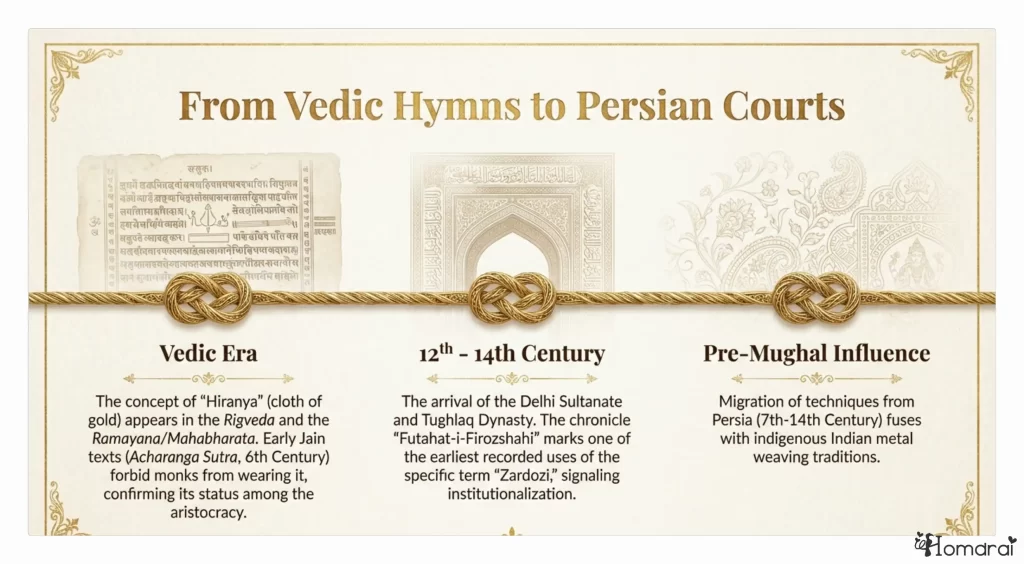
While the term Zardozi is indelibly linked to Islamic heritage in India, the tradition of adorning fabric with precious metals predates the arrival of the Mughals. Ancient Indian literary sources provide compelling evidence of indigenous metallic embroidery. The Rigveda, one of the oldest sacred texts, references Hiranya—cloth of gold—suggesting that the weaving or embroidery of gold wires was an established practice in the Vedic era. Similarly, the epics Ramayana and Mahabharata describe royal attires that gleamed with the luster of gold, implying a sophisticated knowledge of metallurgy in textiles. Historians also point to the Acharanga Sutra (6th century), a Jain text that explicitly forbids monks from wearing gold-embroidered clothes, a prohibition that paradoxically confirms the prevalence of such luxury items among the laity and aristocracy of the time.
However, the specific stylistic and technical repertoire that defines Zardozi today—the use of the Adda (frame), the Aari (hook), and the distinct floral and geometric vocabulary—traces its lineage to Persia (modern-day Iran). Historical records posit that the craft originated in Persia around the 7th to 14th centuries and migrated to the Indian subcontinent through waves of trade and conquest. The initial introduction is often attributed to the Delhi Sultanate, specifically during the Tughlaq dynasty. The chronicle Futahat-i-Firozshahi marks one of the earliest recorded uses of the specific term “Zardozi” in the Indian context, indicating that by the medieval period, the craft had begun to institutionalize itself within the royal workshops.
2.2 The Mughal Zenith: Imperial Patronage and Standardization
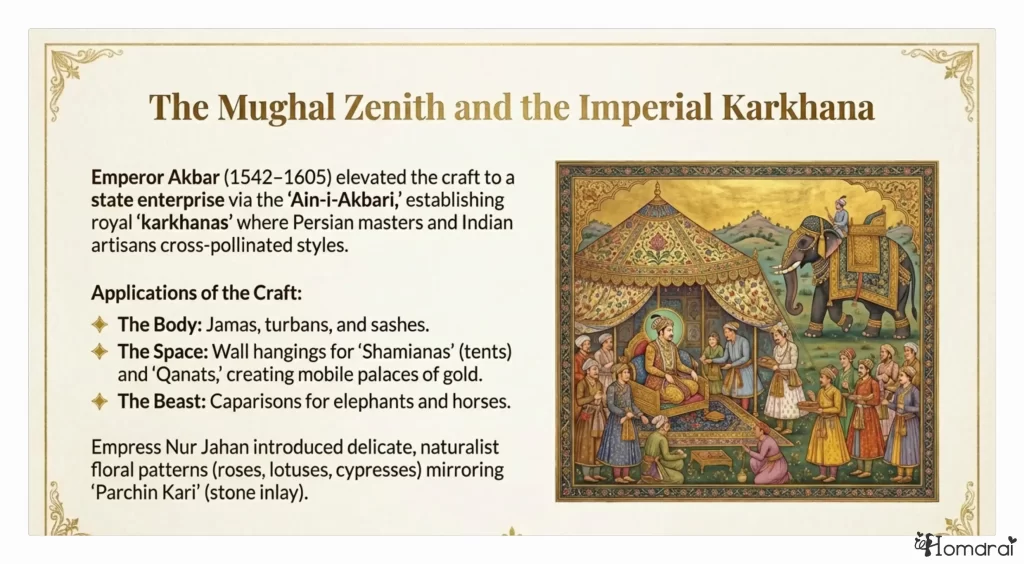
The ascension of the Mughal Empire marked the “Golden Age” of Zardozi. It was under Emperor Akbar (1542–1605) that the craft was elevated from a decorative art to a state enterprise. Akbar’s administration, renowned for its meticulous documentation in the Ain-i-Akbari, established royal karkhanas (workshops) where Persian masters worked alongside Indian artisans, fostering a cross-pollination of styles.
During this era, Zardozi was not confined to personal attire. It became an instrument of imperial projection, adorning:
- The Royal Person: Jamas (coats), turbans, and sashes for the Emperor and his courtiers.
- Architecture: The walls of royal tents (Shamianas and Qanats) were often entirely covered in heavy Zardozi panels, creating mobile palaces of gold during military campaigns.
- Military and Equestrian Gear: Scabbards for swords, quivers for arrows, and elaborate caparisons for regal elephants and horses were embroidered with metal wire to reflect the sun and dazzle beholders.
The aesthetic evolution continued under Jahangir and Shah Jahan, but it was Empress Nur Jahan who is often credited with refining the motifs. Legend suggests she introduced more delicate, naturalist floral patterns—roses, lotuses, and cypresses—mirroring the Parchin Kari (stone inlay) work seen in Mughal architecture.
2.3 The Colonial Interlude and the Crisis of Patronage
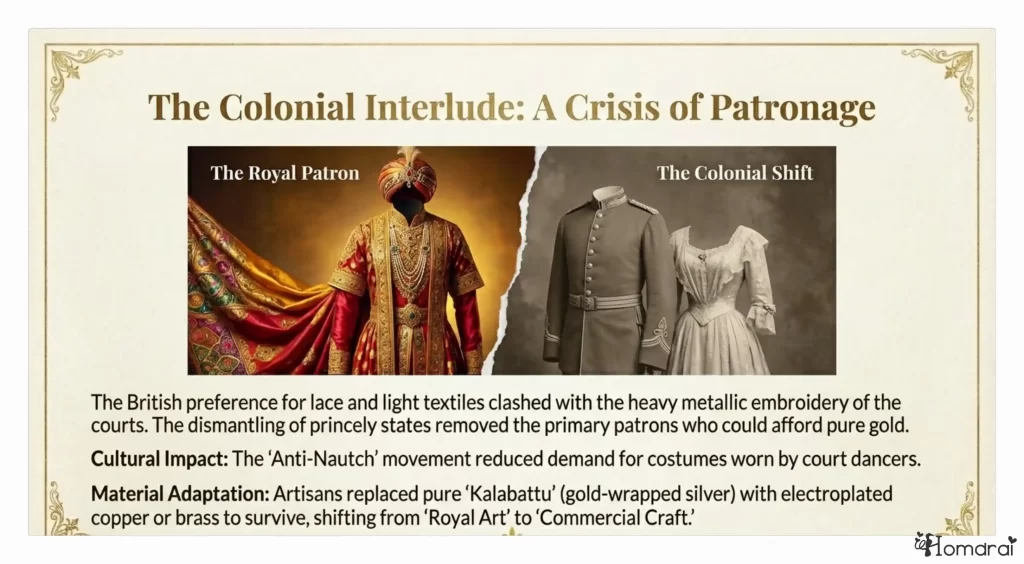
The disintegration of the Mughal Empire and the subsequent establishment of the British Raj precipitated a severe crisis for Zardozi. The British administration lacked the cultural inclination for heavy, metallic embroidery, preferring European lace and lighter textiles. Furthermore, the systematic dismantling of the princely courts removed the primary patrons who could afford the exorbitant cost of pure gold and silver embroidery. The “Anti-Nautch” movement and the changing social mores also reduced the demand for the opulent costumes worn by court dancers, who were significant consumers of Zardozi.
Concurrently, the Industrial Revolution flooded Indian markets with machine-made textiles. To survive, artisans were forced to compromise on materials. The pure Kalabattu (gold-wrapped silver wire) was increasingly replaced by copper or brass wire electroplated with gold, leading to a perceived degradation in quality and a shift from “royal art” to “commercial craft”. Despite these challenges, the craft survived in the resilient pockets of the Old Cities—Delhi’s Shahjahanabad, Lucknow’s Chowk, and Hyderabad’s Charminar—where the landed gentry and local customs continued to sustain the demand.
3. Technical Morphology: Tools, Materials, and Techniques
The distinction of Zardozi lies not just in its visual splendor but in the rigorous, labor-intensive techniques employed to create it. It is fundamentally a method of metal appliqué rather than simple embroidery.
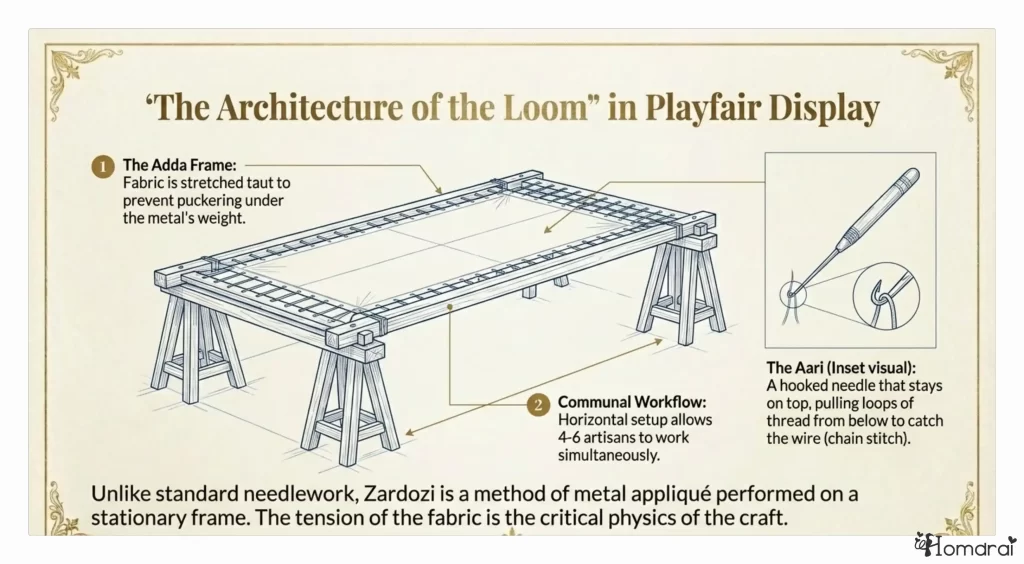
3.1 The Architecture of the Loom: Adda and Aari
The production process begins with the Adda, a large wooden frame that resembles a traditional bed (charpai). The base fabric—historically velvet, heavy silk, or satin—is stretched taut across this frame. This tension is critical; without it, the weight of the metal embellishments would cause the fabric to pucker and sag. The horizontal setup allows multiple artisans (typically 4 to 6) to sit cross-legged around the frame and work simultaneously on a single piece, making Zardozi an inherently communal activity.
The primary tool is the Aari, a specialized needle with a hooked tip. Unlike a standard sewing needle that requires the embroiderer to pass the entire needle through the fabric, the Aari remains on the top surface. The artisan holds the thread underneath the fabric with one hand and uses the hook to pull loops of thread up through the fabric, catching the metal wire or bead and securing it with a chain stitch. This technique allows for rapid execution and precise control over the tension of the wire.
3.2 Material Taxonomy: The Vocabulary of Wire
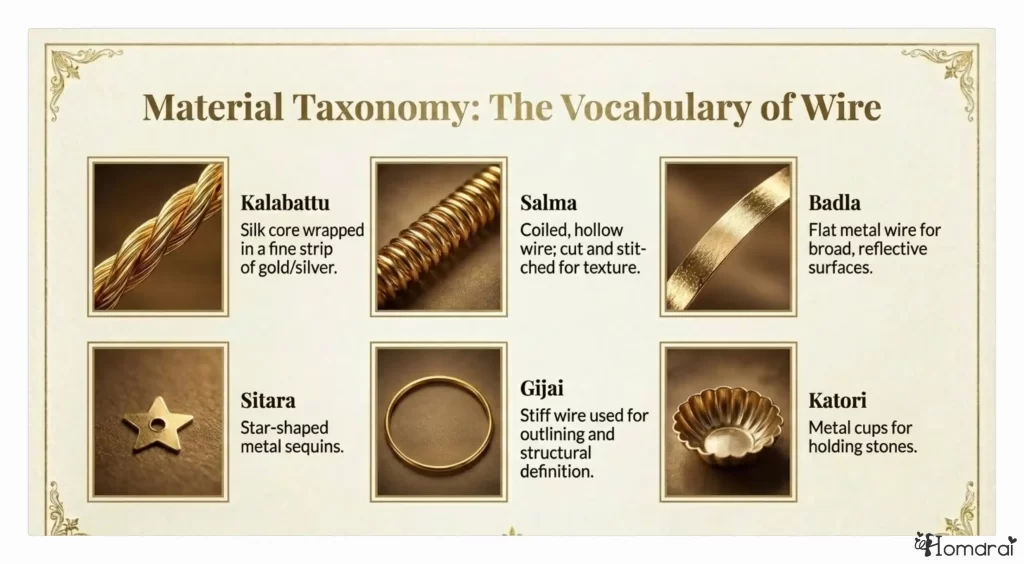
The terminology of Zardozi materials reflects its complexity. The wires and embellishments are not uniform; they vary in shape, texture, and function:
- Kalabattu: The most prestigious thread, consisting of a silk core wrapped in a fine strip of gold or silver.
- Badla: A flat metal wire, often used to create broad, reflective surfaces within a motif.
- Salma: A coiled, spring-like wire. It is hollow and can be cut into small pieces and stitched down to create texture.
- Sitara: Small, star-shaped sequins made of metal, used to add glitter and fill negative spaces.
- Gijai: A thin, stiff, circular wire, typically used to outline motifs and provide structural definition.
- Katori: Small metal cups used to hold precious stones or pearls in place.
In the contemporary era, the use of pure bullion is rare. Most “gold” Zardozi today utilizes copper wire that has been silver-plated and then gold-plated, or even polyester threads (Lurex) that mimic the metallic sheen at a fraction of the cost.
3.3 Stylistic Dichotomy: Karchobi vs. Kamdani
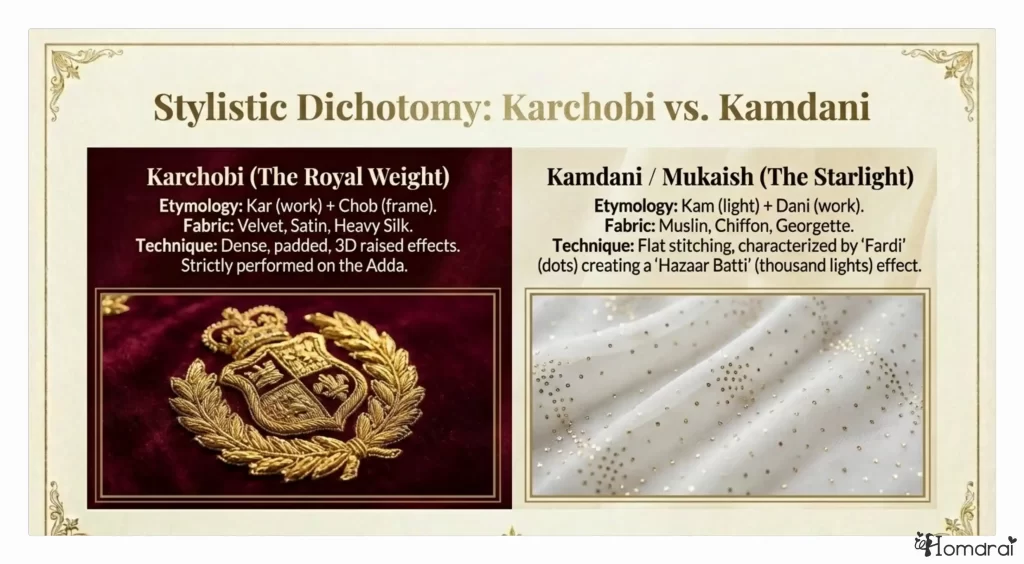
Within the Zardozi spectrum, there are two distinct sub-genres, differentiated by the weight of the fabric and the density of the embroidery.
Table 1: Technical Comparison of Karchobi and Kamdani
| Feature | Karchobi | Kamdani (Mukaish) |
| Etymology | Kar (work) + Chob (frame). | Kam (less/light) + Dani (vessel/work). |
| Base Fabric | Heavy textiles: Velvet, Satin, Heavy Silk. | Fine textiles: Muslin, Chiffon, Georgette, Silk. |
| Technique | Dense, heavy stitching; often padded with cotton to create a 3D, raised effect. | Lighter, flat stitching; characterized by Fardi (dots) made by flattening wire. |
| Application | Tent hangings, scabbards, bridal lehengas, furnishing, shoes, animal trappings. | Veils, dupattas, caps, scarves, lighter garments. |
| Execution | Strictly performed on the stationary Adda. | Can be performed with a needle without a massive frame. |
Karchobi is the quintessential “Zardozi” of royal courts, designed to impress with weight and opacity. Kamdani, often overlapping with Mukaish or Badla work in Lucknow, creates a twinkling, starlight effect (Hazaar Batti or thousand lights) on translucent fabrics, making it more suitable for summer wear and veils.
4. The Geographical Cartography: Centers, Villages, and Clusters
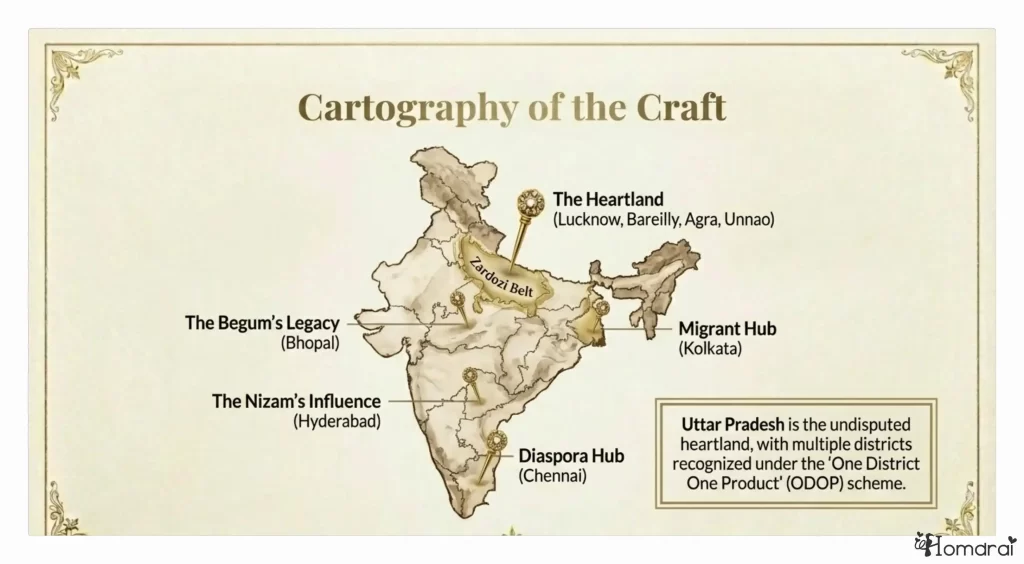
The practice of Zardozi is unevenly distributed across the Indian subcontinent. While Uttar Pradesh serves as the undisputed heartland, distinct variations and artisan communities thrive in Madhya Pradesh, Telangana, Tamil Nadu, and West Bengal. This section provides a granular analysis of these clusters.
4.1 Uttar Pradesh: The Zardozi Heartland
Uttar Pradesh (UP) hosts the largest concentration of Zardozi artisans globally. The craft is so integral to the state’s economy that it has been identified under the “One District One Product” (ODOP) scheme for multiple districts.
4.1.1 Lucknow: The Cultural Capital (GI Tagged)
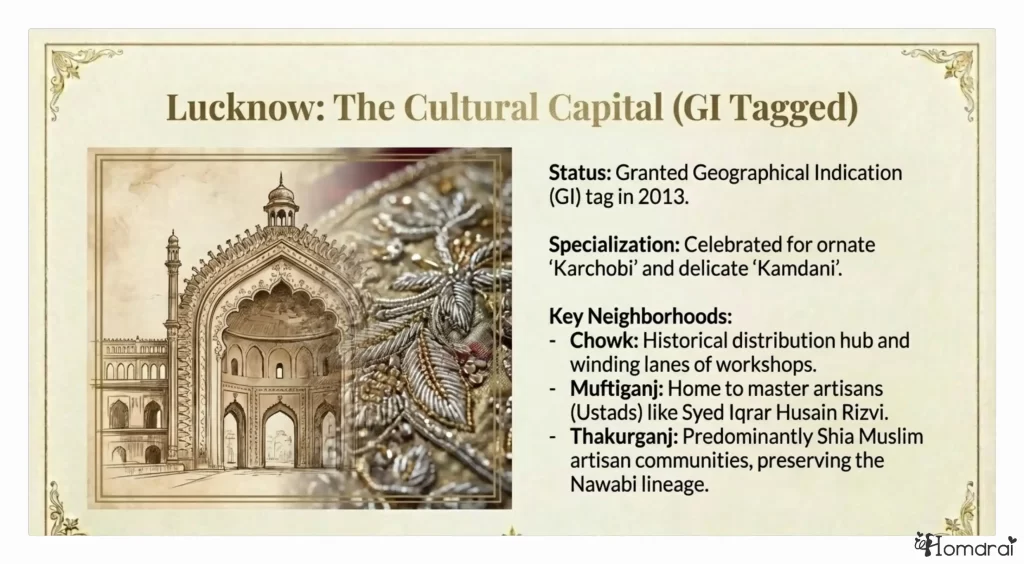
Lucknow is the nerve center of the craft. The “Lucknow Zardozi” Geographical Indication (GI) tag, granted in 2013, recognizes the unique heritage of the region. The Lucknow style is celebrated for its ornate Karchobi on velvet and the delicate Kamdani on muslin.
Key Artisan Clusters and Mohallas: Research identifies specific neighborhoods where the craft is a household industry:
- The Old City (Chowk): The winding lanes of Chowk are lined with workshops. This area is the historical distribution hub.
- Muftiganj: A densely populated artisan hub. Specific addresses of master artisans (Ustads) such as Syed Iqrar Husain Rizvi and Huma Rizvi are located in Hata Mubarak, Haidari Imambara, and Girdhari Lal Mathur Road. These names and locations represent the living lineage of the craft.
- Thakurganj & Musahabganj: These neighborhoods house numerous karkhanas. The community here is predominantly Shia Muslim, a demographic continuity from the Nawabi era.
- Sahadatganj & Hussainabad: Areas known for bulk production, where entire families, including women, participate in the preliminary stages of the work.
4.1.2 Bareilly: The Production Powerhouse (GI Tagged)
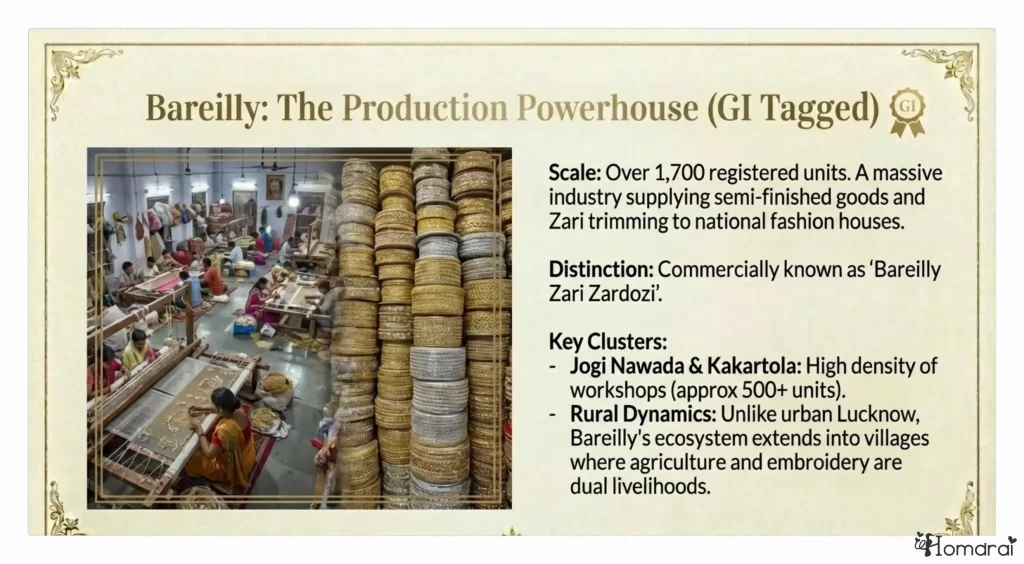
While Lucknow holds the cultural prestige, Bareilly functions as the commercial engine. The “Bareilly Zari Zardozi” also holds a GI tag. The industry here is massive, with data indicating over 1,700 registered units in specific clusters. Bareilly is particularly known for Zari trimming and supplying semi-finished goods to fashion houses in Delhi and Mumbai.
Key Artisan Villages & Clusters:
- Jogi Nawada: A major concentration of artisans, hosting approximately 200 units.
- Kakartola (Purana Sheher): Located in the Old City, this area has a high density of workshops (approx. 500 units).
- Chaknavada & Arbitola: These clusters collectively house around 1,000 units, indicating the sheer scale of production in this district.
- Rural Dynamics: Unlike the urban-centric Lucknow craft, Bareilly’s Zardozi ecosystem extends deep into the surrounding villages, where agriculture and embroidery often coexist as dual livelihoods.
4.1.3 Agra: The Imperial Legacy (ODOP)
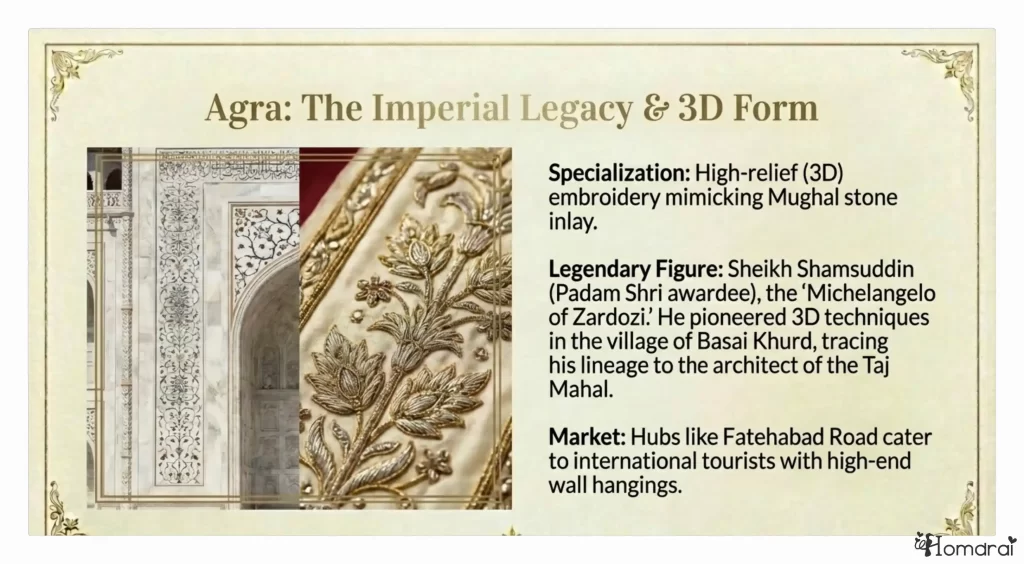
As the former capital of the Mughal Empire, Agra’s Zardozi tradition is steeped in history. The city is famous for heavy, high-relief (3D) embroidery that often mimics the floral inlay work of the Taj Mahal.
Key Artisan Clusters:
- Basai Khurd: This village near the Taj Mahal is legendary in Zardozi circles. It was the home of the late Sheikh Shamsuddin, a Padam Shri awardee known as the “Michelangelo of Zardozi.” He pioneered the 3D Zardozi technique, creating raised motifs that looked like sculptures on fabric. His grandson, Faizan Uddin, continues this legacy, tracing their lineage back to Ustad Ahmed Lahori, the architect of the Taj Mahal.
- Raja Ki Mandi: Home to skilled artisans like Mohd. Bilal, who specialize in creating intricate wall hangings and accessories for the export market.
- Kinari Bazar: The traditional market for raw materials and finished goods.
- Fatehabad Road: A hub for high-end emporiums (e.g., Sanskriti Gems, Art Emperio) that cater to international tourists, sourcing their exquisite pieces directly from the local artisan villages.
4.1.4 The Satellite Clusters: Unnao, Farrukhabad, and Beyond
- Unnao: Located between Kanpur and Lucknow, Unnao is an ODOP district for Zari-Zardozi. It serves as a spillover production hub, benefiting from the logistical connectivity to Lucknow.
- Farrukhabad: While famous for textile printing, Farrukhabad has a symbiotic Zardozi industry. Villages like Bhikampura and Bharka are notable hubs where Zardozi is used to embellish printed textiles.
- Varanasi: Here, Zardozi intersects with weaving. The Sundarpur and Madanpura areas are known for adding Zardozi embellishments to the famous Banarasi silk sarees, creating a double-layer of value.
- Budaun, Shahjahanpur, Kasganj: These districts have been identified as emerging clusters where Zardozi is a primary livelihood for rural women, supported by government training programs.
4.2 Madhya Pradesh: The Begums’ Legacy
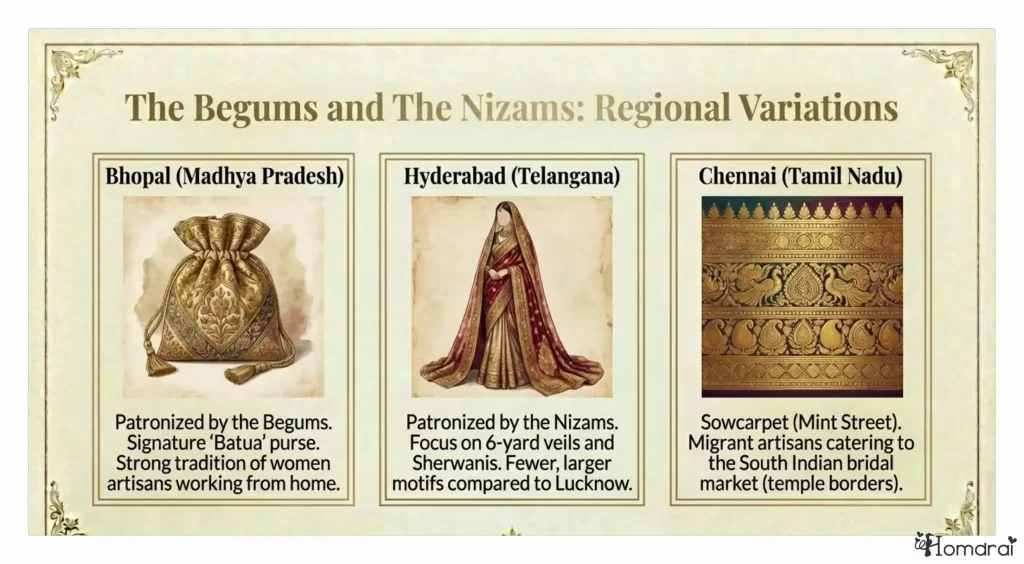
In Madhya Pradesh, the craft is centered in Bhopal.
- Historical Context: The craft was heavily patronized by the Begums of Bhopal (the female rulers), who encouraged it as a respectable vocation for women.
- The Bhopali Batua: The signature product of this region is the Batua, a small string purse heavily embroidered with Zardozi. It is considered a cultural icon of the city.
- Gender Dynamics: Unlike UP, where men historically dominated the Adda, Bhopal has a strong tradition of women artisans working from home. The Old City (Chowk) remains the commercial heart, but production is decentralized across residential colonies.
4.3 Southern India: The Nizam and The Migrant
4.3.1 Hyderabad (Telangana)
Hyderabadi Zardozi, patronized by the Nizams, is distinct in its aesthetic. It is extensively used on the Khada Dupatta (a traditional 6-yard veil) and Sherwanis. The style often involves fewer but larger motifs compared to the dense “fill-all” style of Lucknow.
- Key Clusters: The historic markets surrounding the Charminar, specifically Lad Bazar and Gulzar Houz, are lined with Zardozi workshops. Residential areas like Falaknuma and Lal Darwaza in the Old City host numerous home-based units.
4.3.2 Chennai (Tamil Nadu)
Chennai represents a unique diaspora cluster. The Zardozi workers here are primarily migrants from the Saurashtra region or Muslim communities from North India who settled generations ago.
- Sowcarpet: The Mint Street area in Sowcarpet is the epicenter. This neighborhood functions as a “Mini North India” within Chennai. The workshops here cater specifically to the South Indian bridal market, blending traditional northern techniques with southern motifs (like temple borders and mango designs).
4.4 Other Significant Regions
- Kashmir: Known for a fusion of Kashida (needlework) and Zardozi. The work here often uses copper wire on wool or silk, creating a distinct textural contrast.
- Kolkata (West Bengal): The Howrah district, particularly Chakmadhu, has emerged as a major hub. Interestingly, many “Zardozi” artisans in Kolkata are migrants from Bihar and UP who moved there for better wages. Kolkata Zardozi is famed for its fineness and is a preferred sourcing hub for high-end designers like Sabyasachi.
- Delhi: The historic capital remains a hub for trading and high-end manufacturing, particularly in the Shahjahanabad (Old Delhi) and Kinari Bazar areas, supplying the capital’s booming bridal fashion market.
5. Socio-Economic Architecture and Labor Dynamics
5.1 The Karkhana Structure and Supply Chain
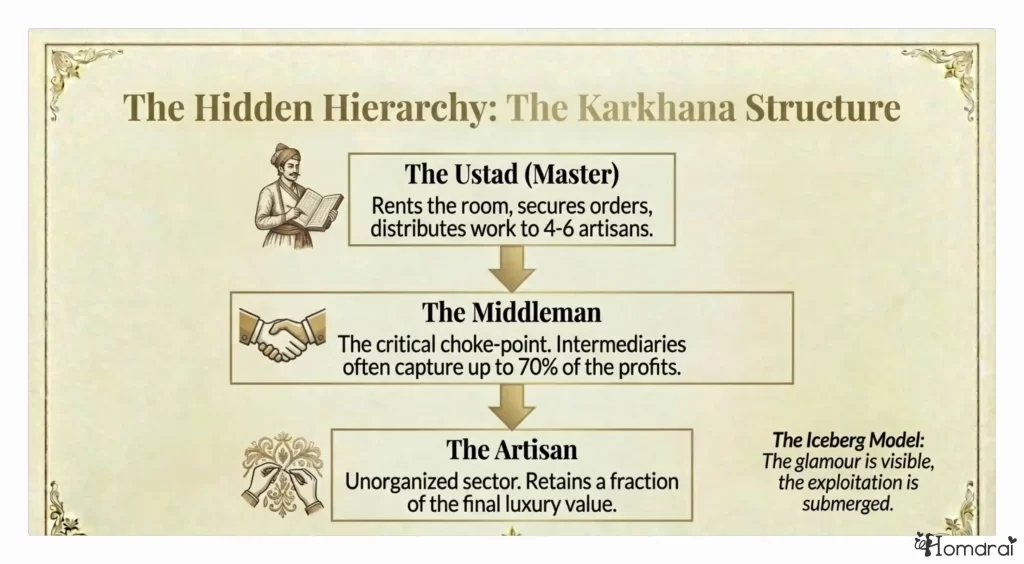
The Zardozi sector is overwhelmingly unorganized. While cities like Bareilly boast over 1,700 units, the actual number of artisans is difficult to track due to the informal nature of home-based work. The production model typically follows the Karkhana (workshop) system:
- The Master Craftsman (Ustad): He rents a small room where 4-6 artisans work. He secures orders from traders or designers and distributes the work.
- The Middlemen: The supply chain is plagued by multiple layers of intermediaries. Studies indicate that middlemen often capture up to 70% of the profits, leaving the primary artisan with a fraction of the value.
- Wages: Artisans are typically paid by the piece or by the weight of the wire stitched. Daily earnings can range from a meager ₹100 to ₹300, a sum that fails to reflect the skill and physical toll of the work.
5.2 Occupational Health Hazards
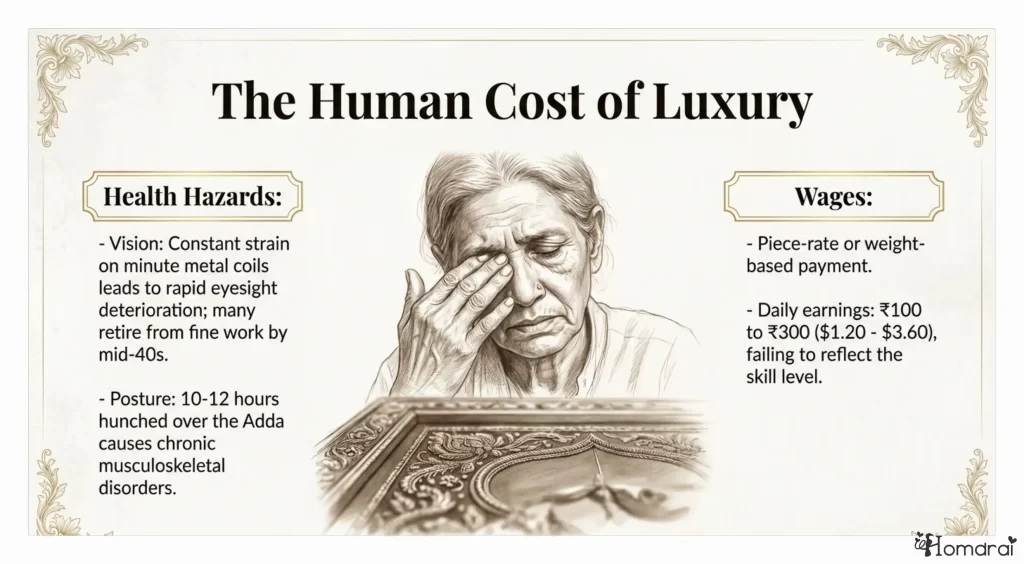
The physical cost of Zardozi is high. Artisans work for long hours (10-12 hours) in hunched postures over the Adda. The work requires intense focus in often poorly lit rooms. This leads to a high prevalence of:
- Musculoskeletal Disorders: Chronic back and neck pain are ubiquitous.
- Vision Impairment: The constant strain of stitching minute metal coils leads to rapid deterioration of eyesight, forcing many artisans to retire from fine work by their mid-40s.
5.3 Gender Shift: The Feminization of the Craft
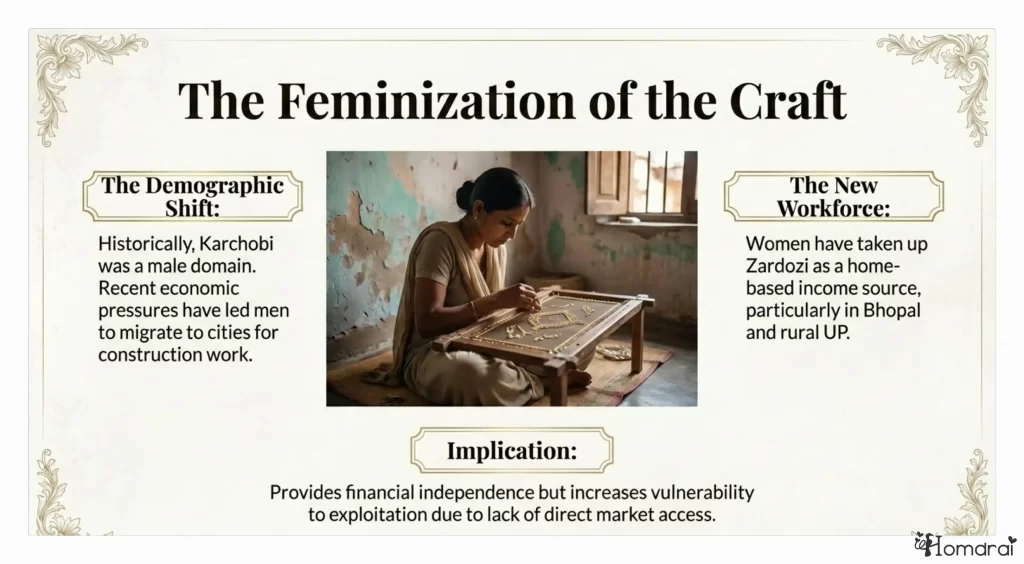
Historically, Karchobi (heavy work) was a male domain, while women practiced lighter embroidery within the zenana. However, recent economic shifts have altered this demographic. In cities like Bhopal and rural districts of UP, there is a trend toward the “feminization” of the craft. With men migrating to metropolitan cities for construction or factory work, women have taken up Zardozi as a home-based income source. While this provides financial independence, female artisans often face greater exploitation due to lack of direct market access and reliance on male intermediaries.
5.4 Government Interventions: GI and ODOP
To combat the decline and exploitation, the Indian government has deployed legal and economic shields.
Table 2: Government Schemes Supporting Zardozi
| Scheme | Details | Impact |
| Geographical Indication (GI) | Registers specific regional varieties (e.g., Lucknow Zardozi, Bareilly Zari Zardozi). | Prevents unauthorized duplication; certifies authenticity for export. |
| One District One Product (ODOP) | UP Govt scheme identifying Zardozi as the signature craft for 7+ districts (Unnao, Bareilly, etc.). | Provides marketing support, soft loans, and skills training. |
| SFURTI | Scheme of Fund for Regeneration of Traditional Industries. | Used in clusters like Shahjahanpur to organize artisans into collectives for better bargaining power. |
6. Contemporary Renaissance: Fashion, Culture, and Commerce
6.1 The Wedding Economy and Designer Patronage
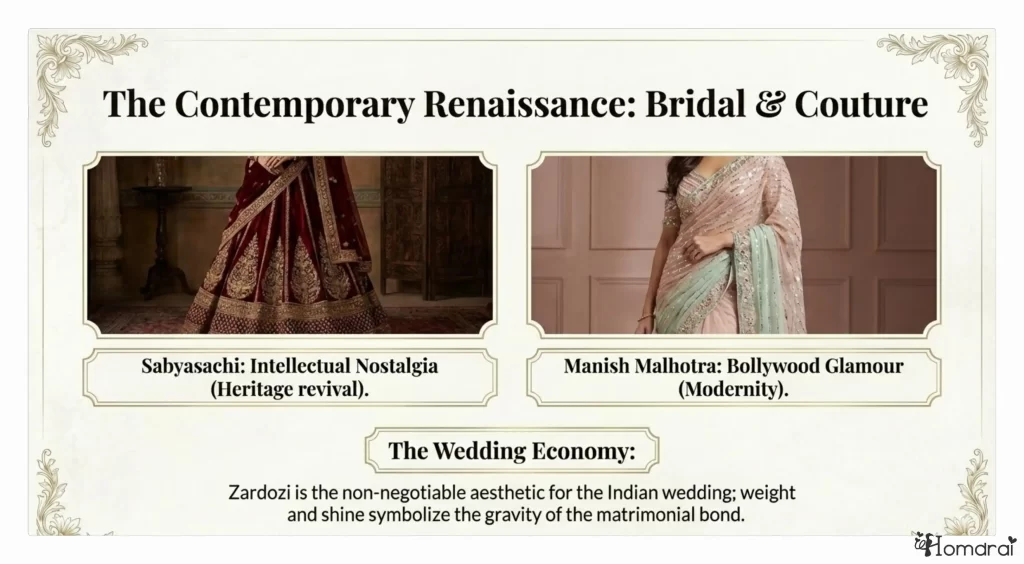
In modern India, Zardozi has transitioned from “royal attire” to “bridal essential.” It is the non-negotiable aesthetic for the Indian wedding industry. The cultural belief holds that the weight and shine of the metal thread convey the gravity and auspiciousness of the matrimonial bond.
India’s premier fashion designers have played a pivotal role in this revival:
- Sabyasachi Mukherjee: A titan of the industry, Sabyasachi uses Zardozi to evoke “intellectual nostalgia.” His collections, such as Charbagh and Devi, heavily feature antique-finish Karchobi work on velvet, reviving the heavy, imperial aesthetic of the Mughals. He sources significantly from Kolkata and West Bengal, blending Zardozi with regional sensibilities.
- Manish Malhotra: Known for “Bollywood Glamour,” Malhotra adapts Zardozi for a more contemporary look. He often mixes Zardozi with Swarovski crystals and sequins, emphasizing the Kamdani style to create fluid, wearable garments that appeal to the modern, globalized Indian bride.
6.2 Religious and Ceremonial Significance
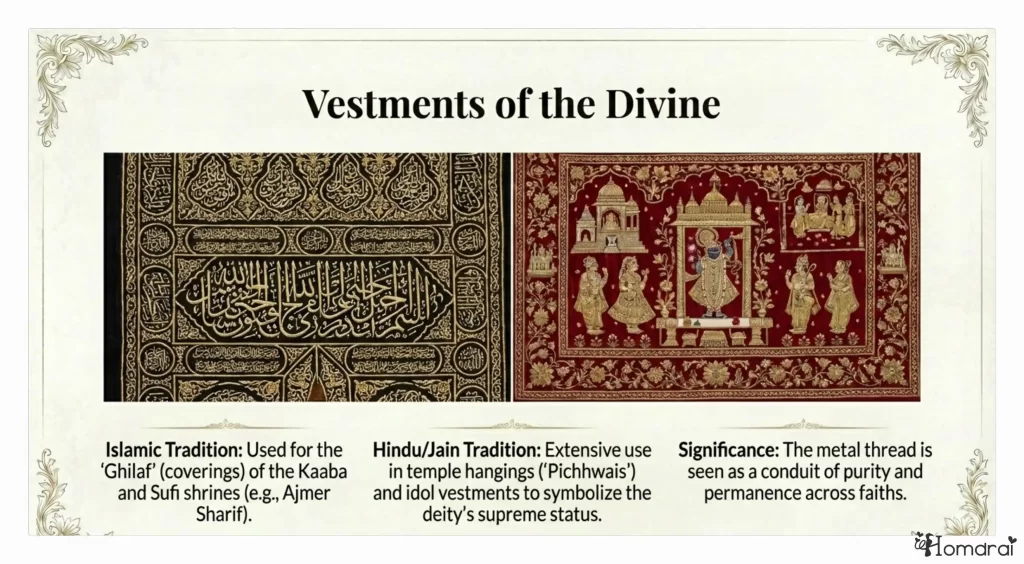
Beyond fashion, Zardozi retains a sacred function.
- Islamic Tradition: It is used to create the Ghilaf (coverings) for the Kaaba and for Sufi shrines (Dargahs) across India, such as the Ajmer Sharif Dargah.
- Hindu/Jain Tradition: Despite ancient prohibitions in some texts, Zardozi is extensively used today in temple hangings (Pichhwais in Rajasthan) and vestments for idols, symbolizing the deity’s supreme status.
6.3 Challenges: The Machine and The Material
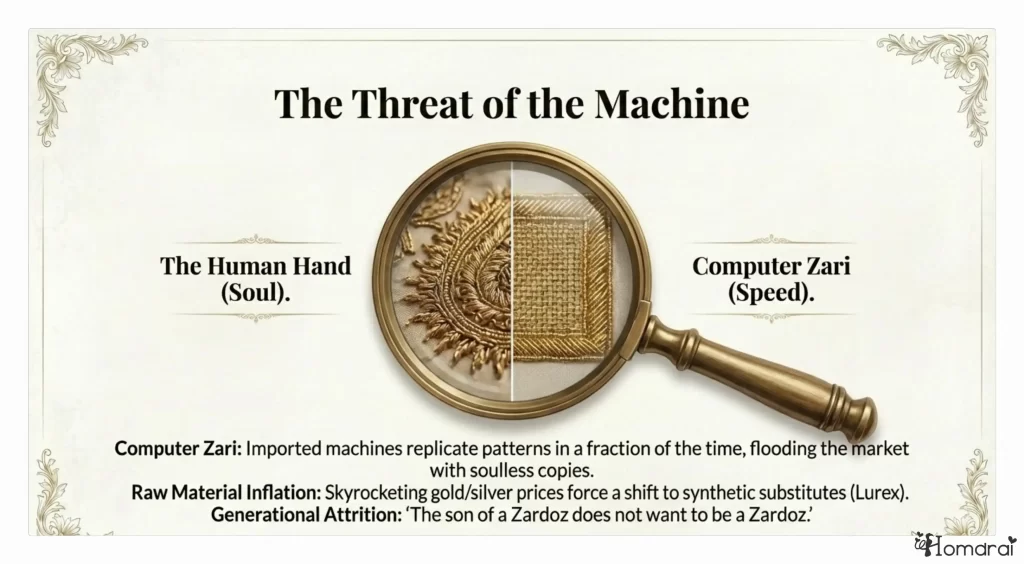
Despite the glamour, the craft faces existential threats:
- Machine Imitation: Computerized embroidery machines (often imported from China) can replicate Zardozi patterns in a fraction of the time and cost. This “Computer Zari” floods local markets, making it difficult for consumers to distinguish authentic handwork.
- Raw Material Inflation: The skyrocketing price of silver and gold has forced the market toward synthetic substitutes. While this democratizes the product, it risks diluting the “luxury” branding that justifies the high labor cost of hand embroidery.
- Generational Attrition: The children of master artisans are increasingly disinterested in the trade. Low wages and lack of social prestige drive them toward other professions. “The son of a Zardoz does not want to be a Zardoz” is a common sentiment in the alleys of Bareilly and Lucknow.
7. Conclusion
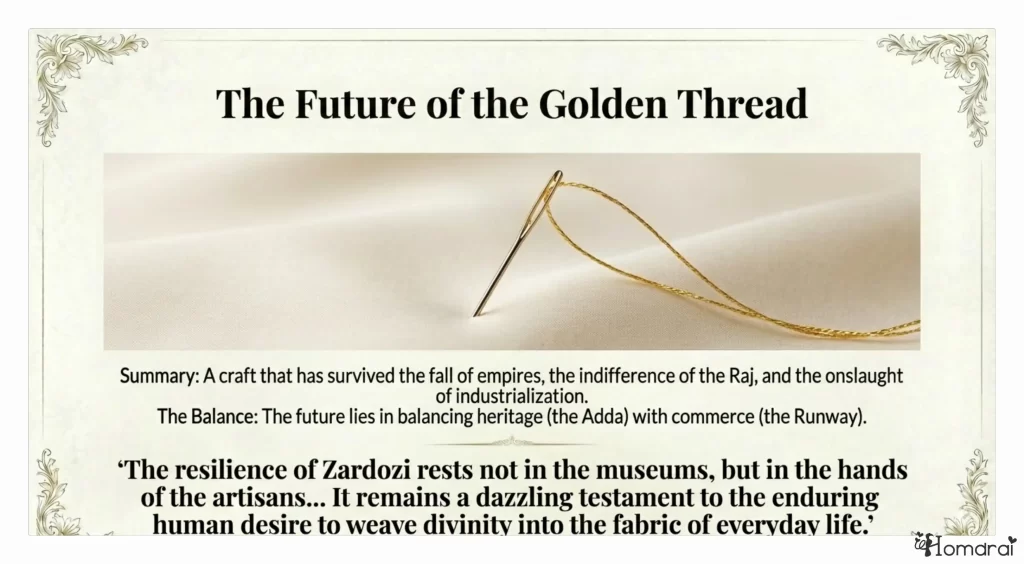
Zardozi is more than a technique of embroidery; it is a metallic chronicle of the Indian subcontinent’s history. From the illuminated tents of Emperor Akbar to the bustling Karkhanas of Bareilly and the high-fashion runways of Mumbai, the “Golden Thread” has stitched together diverse eras and cultures. It is a craft that has survived the fall of empires, the indifference of colonial rule, and the onslaught of industrialization.
The future of Zardozi lies in the delicate balance between heritage and commerce. While government initiatives like GI tags and ODOP provide a structural framework for survival, the true resilience of the craft rests in the hands of the artisans—in the mud-walled workshops of Basai Khurd and the crowded lofts of Muftiganj. Their ability to adapt the rigors of the Adda to the demands of the modern world will determine whether this ancient art form remains a living tradition or becomes a museum relic. As it stands, Zardozi remains a dazzling testament to the enduring human desire to weave divinity into the fabric of everyday life.